Knee Scooter vs Walker: Which Should You Choose? (October 2026)
Choose a knee scooter if your injured foot can rest on a knee pad and you can steer safely; choose a standard walker when you need hand support while standing and stepping. Your injury, balance, home layout and clinician’s instructions should guide the choice.
On this page (9 sections)
- Knee Scooter vs Walker: Which Should You Choose?
- Knee scooter vs walker: how do they support you?
- Which device suits a foot or ankle injury?
- How do balance and strength affect the choice?
- Which is easier to use at home?
- Can you use either aid outdoors?
- What should you check before choosing a knee scooter?
- When should you ask for another mobility aid?
- How do you choose between a knee scooter and walker?
Knee Scooter vs Walker: Which Should You Choose?
Choose a knee scooter if your injured foot can rest on a knee pad and you can steer safely; choose a standard walker when you need hand support while standing and stepping. In a knee scooter vs walker comparison, your injury instructions and ability to control the device matter most.
A knee scooter has a padded platform for the injured leg, handlebars and wheels. A standard walker has a frame you hold while standing and stepping; it does not have a knee platform or steering wheels.
Ask your clinician which movement is allowed before choosing. For a wider view of the options, see our guide to a mobility device for a broken leg.

 Best for higher weight capacity
Drive Medical Adjustable Steerable Knee Walker Scooter
Knee scooter vs walker: how do they support you?
A knee scooter supports the injured leg on a pad while you move with the other leg; a standard walker gives you handholds as you step. They address different mobility needs, so neither is the right choice for everyone.
With a knee scooter, you place the affected lower leg on the padded platform, grip the handlebars and propel yourself with the other leg. The wheels carry the device, so you need enough balance and coordination to steer, brake and keep the free foot moving safely.
A standard walker stays in front of you as you stand and take steps. You hold its handles for support, advance it as instructed and move within its frame.
The exact technique depends on the walker style and your care plan.
What does a standard walker mean here?
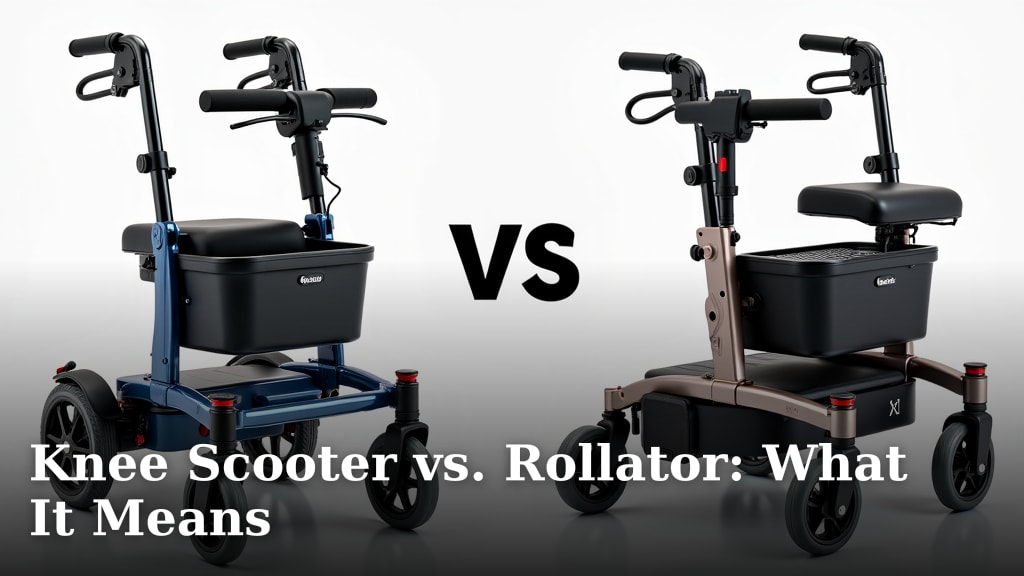
A standard walker is a hand-supported frame, usually used by lifting or moving it forward before stepping. It differs from a rollator, which has wheels and hand brakes, and from a knee walker, which has a platform for one knee.
If you are comparing a knee scooter with a wheeled frame, read Knee Scooter vs. Rollator: What It Means.
The rollator comparison is useful because wheel layout and braking change how the device moves.
Which device suits a foot or ankle injury?
A knee scooter may suit an injury that allows the lower leg to rest on its pad, while a walker may suit someone who needs hand support during steps. The clinician’s weight-bearing instructions decide whether either option is appropriate.
A scooter can reduce the number of steps you take on the uninjured side, but it still requires that leg to propel you. It also requires safe turning and braking.
If you cannot keep control of the scooter or are told not to use a knee platform, consider another aid with your care team.
A standard walker can provide a handhold while you advance your body and manage steps. It takes arm strength, coordination and practice.
Ask a physical therapist to show you how to keep the injured foot within its permitted weight limit.
Should you use a knee scooter with a walking boot?
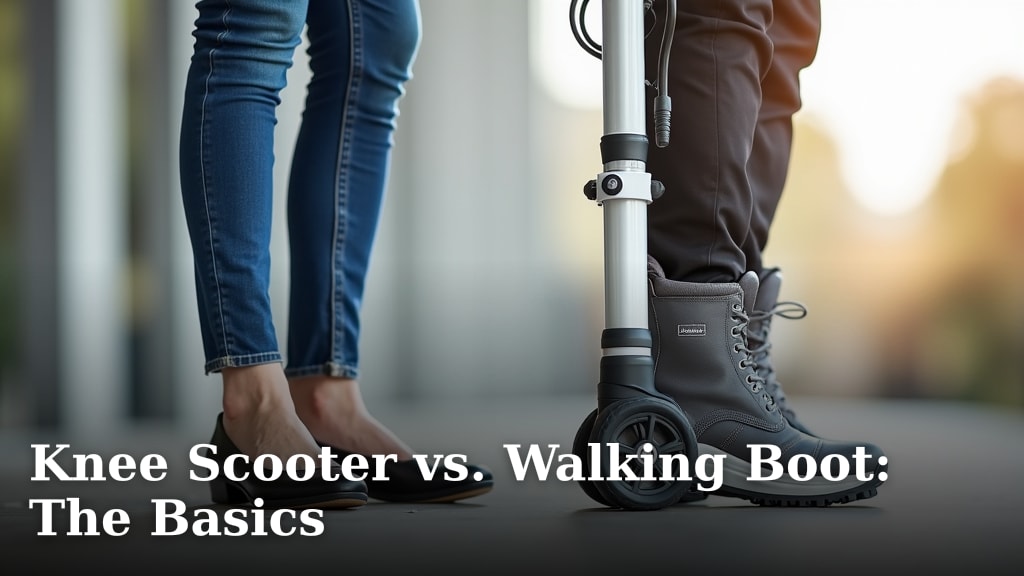
A boot and a knee scooter serve different roles, and whether they work together depends on your injury instructions. A boot protects the foot or ankle while walking; a knee scooter lets the affected leg rest on a pad while you move.
Don’t assume a boot makes weight-bearing safe. Confirm whether your care plan allows you to use the injured leg on a knee platform or requires it to stay untouched.
Our guide to Knee Scooter vs. Walking Boot: The Basics explains the difference between these aids.
If you’re considering crutches instead, compare your balance, hand strength and daily route with the advice in when to choose crutches over a knee scooter.
How do balance and strength affect the choice?
Choose the device you can control safely with your current balance, leg strength and arm strength. A knee scooter needs steering and braking control; a walker needs arm support and coordinated stepping.
On a scooter, the free leg pushes and helps steer your movement. A sudden turn, uneven threshold or crowded space can make control harder.
Practice in an open area, and stop if you cannot brake or steer reliably.
With a standard walker, your arms and hands help steady your body as you move. Weak grip, shoulder pain or difficulty coordinating each step may affect your ability to use it.
A clinician or therapist can assess these needs and recommend a device that matches them.
When might a cane be enough?
A cane is a lighter support option for some people, but it provides less support than a walker. It may fit when you can walk safely and need limited help with balance, rather than a way to keep an injured foot off the ground.
A cane usually requires you to bear some weight through the legs. Check your care plan before relying on one for an injury.
For more on how the options differ, see Knee Scooter vs. Cane: Everything to Know.
Which is easier to use at home?
A walker may suit a home with tight turns or small rooms, while a knee scooter needs enough open space to steer and stop. Measure your route, including doorways, hallways, bathroom entries and turns.
A walker can be easier to position in a small area because it advances with your steps. It still needs clearance for the frame, and stairs can make any mobility aid more challenging.
Ask for a home safety plan if your route includes steps.
A knee scooter rolls along the floor and may need more turning room. Check thresholds and surface changes before using it.
Loose rugs, clutter and narrow doorways can interrupt movement or make braking difficult.
Use painter’s tape to mark the device’s width and turning space in busy areas. Consider how you’ll carry a phone, meal or personal item, since a free hand may be needed for support or control.
Can you use either aid outdoors?
Choose an outdoor route based on the exact device, surface and your ability to control it. Smooth paths are generally easier to manage than loose, uneven ground, but follow the device manual and your clinician’s advice.
A standard walker can be difficult to move across rough ground or long distances. Some walkers have wheels, but that changes how they roll and brake.
Don’t treat a rollator as the same device as a basic frame.
Knee scooters also vary by wheel and brake design. The Drive Medical scooter’s maker advises against inclines above 15 degrees, loose gravel and uneven surfaces, and warns against traveling over curbs or parking stops.
Check the instructions for the exact model and avoid obstacles you can’t cross safely.
If regular travel is difficult or you need to sit while moving, another mobility option may fit better. Our guide on how to choose a wheelchair covers wheelchairs and transport chairs, while mobility scooter vs power wheelchair compares powered options.
What should you check before choosing a knee scooter?
Check fit, brakes, folding needs and weight capacity before choosing a knee scooter. The device only helps if you can position the injured leg comfortably and control the scooter along your daily route.
The BodyMed Knee Walker has adjustable steering and knee pad columns, a foldable steering column and detachable components. BodyMed recommends it for users from 4 ft 9 in to 6 ft 4 in, with a maximum capacity of 300 lb.
The Drive Medical Adjustable Steerable Knee Walker Scooter has 8-inch casters, a removable basket and a stated 350 lb capacity. The maker identifies it for recovery from foot surgery, breaks, sprains, amputation and foot ulcers.
The BlessReach Foldable All Terrain Knee Scooter has 11-inch front wheels, 8-inch rear wheels, disc brakes and folding handlebars. Its recommended user height is 5 ft 6 in to 6 ft 6 in, and its capacity is 300 lb.
The KneeRover Deluxe KneeCycle has 7.5-inch wheels, an adjustable locking handbrake and a rear drum brake. Its stated height range is 4 ft 9 in to 6 ft 6 in.
These products are knee walkers, not standard walkers. For a broader selection process, see How Do You Really Choose a Knee Scooter?.
When should you ask for another mobility aid?
Ask your care team about another aid if you cannot use a knee platform or walker safely, or if your home and route don’t suit either. A wheelchair or transport chair may help when walking or steering is not practical.
Your options depend on more than the injury. Consider whether you can propel a scooter, support yourself through your arms, transfer in and out of a seat and move through your home.
A clinician or therapist can account for these needs and your weight-bearing limits.
Don’t choose a powered mobility device based only on its name or appearance. It has different space, transfer and control needs from a manual knee scooter or walker.
How do you choose between a knee scooter and walker?
Choose a knee scooter if your clinician approves the knee platform and you can steer, brake and propel it; choose a walker if you need hand support while stepping. If neither feels safe, ask your care team to assess another aid.
For a foot injury and an approved knee platform, compare fit and route conditions before selecting a scooter. If you need support while walking, focus on the walker style and the technique a therapist teaches you.
A knee scooter vs walker decision should follow your care plan, then your balance, strength and home layout. Measure tight spaces, practice the device and ask for help if you cannot control it confidently.
Frequently asked questions
Is a knee scooter better than a walker for a broken foot?
A knee scooter may suit a broken foot when your care team allows you to rest the injured leg on its pad and you can steer safely. A standard walker may be a better fit when you need hand support for standing and stepping.
Follow your clinician’s weight-bearing instructions.
Can you use a knee scooter if you have poor balance?
A knee scooter requires you to balance while steering and moving on wheels, so poor balance can make it harder to use safely. Ask a clinician or physical therapist to assess your mobility and practice with the device before relying on it, especially around turns and thresholds.
Can a standard walker keep weight off a foot?
A standard walker can help support you as you step, but how much weight reaches an injured foot depends on your technique and care instructions. Have a clinician or physical therapist show you the correct pattern for your injury and confirm whether the foot must stay fully non-weight-bearing.
Can you use a knee scooter inside a house?
A knee scooter can work indoors if you have enough room to turn and the route has suitable floors, doorways and thresholds. Measure tight spaces and remove loose rugs or clutter.
Practice braking and turning before using it around furniture or in a busy room.
Should you choose a knee scooter or walker without asking a clinician?
Ask your clinician which device fits your injury and weight-bearing limits before choosing. A knee scooter rests the injured leg on a pad, while a standard walker supports stepping with your hands.
The right choice also depends on balance, strength, stairs and your home layout.