How to Choose a Knee Scooter for Kids
A knee scooter for kids must fit the child’s height and injured leg, and the child must be able to steer and brake safely. Confirm pediatric sizing and use with the child’s clinician before choosing a model made for adults.
On this page (5 sections)
A knee scooter for kids should fit the child’s height and injured leg, with controls the child can reach and use safely. Ask the child’s clinician to confirm that a knee walker is suitable before buying, since the adult models below may not adjust small enough.
Check the height range, platform position, steering and brakes together. An adjustable adult scooter is not automatically a pediatric knee walker.
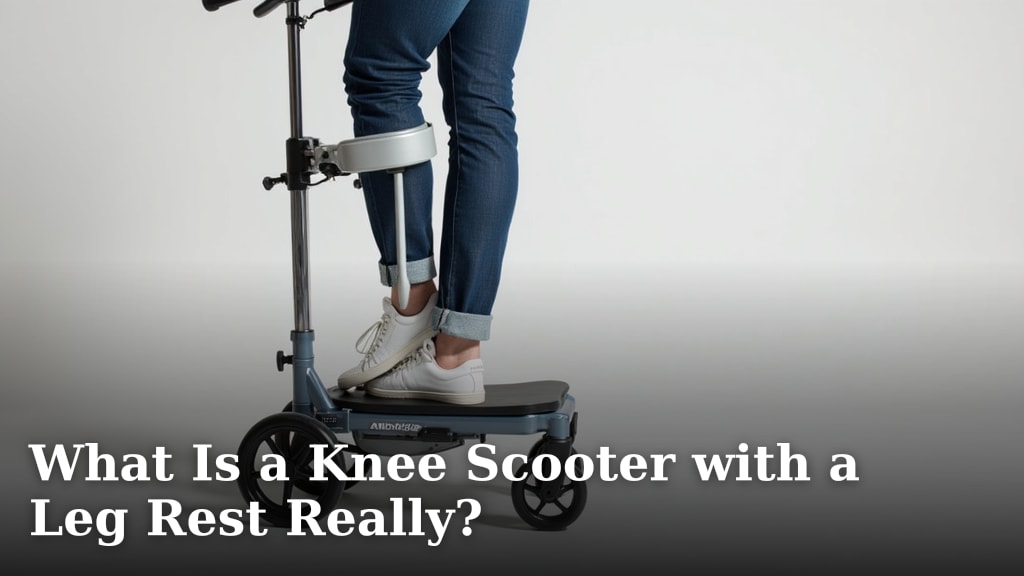
For an overview of available designs, see Types of Knee Scooters: A Practical Guide. A model with a leg rest works differently from a standard knee pad, as explained in What Is a Knee Scooter with a Leg Rest Really?.
What should you check before choosing a knee scooter for kids?
Start with clinician approval and a size check. The child needs to fit the model’s height range and use its platform, handlebars and brake without reaching or leaning awkwardly.
Check these points before comparing colors or extras:
| Fit check | What to confirm |
|---|---|
| Height | The child falls within the manufacturer’s recommended range |
| Knee platform | The injured leg rests securely and comfortably on the pad |
| Handlebar reach | The child can steer without stretching or leaning forward |
| Brake use | The child can squeeze and release the brake as instructed |
| Stability | The child can balance while mounting, riding and stopping |
| Setting | The intended paths are smooth, level and clear of obstacles |
Ask the clinician how the child’s injured leg should rest on the pad and whether a scooter fits the recovery plan. Do not put weight on the injured foot unless the clinician says it is allowed.
How do you check a knee walker’s height range?
Compare the child’s height with the model’s stated recommended range, then check the fit in person if possible. Height ranges help screen options, but they do not replace a supervised fit check.
The adult models described here have minimum recommended heights of 5 ft 3 in or 5 ft 6 in. Those starting points may rule them out for many children, even though their handlebars and knee platforms adjust.
During a fit check, have an adult nearby and follow the clinician’s instructions. The child should be able to stand upright, reach the handlebars and brake, and rest the injured leg on the platform without twisting or stretching.
If the child is below the recommended height, do not assume that lowering an adjustment makes the scooter suitable. Ask the clinician or a mobility equipment supplier about a pediatric knee walker sized for the child.
How should the knee platform fit?
The injured leg should rest securely on the knee pad in the position recommended by the clinician. A platform that is too high, too low or poorly placed can make it harder to steer and maintain balance.
Check where the child’s knee and lower leg sit, not just the pad’s length and width. The child should not have to slide forward, twist the leg or lean heavily on the handlebars to reach the pad.
Ask the clinician how much of the leg should contact the platform and whether padding or a different support is needed. A standard adult pad may not match a child’s leg shape or mobility needs.
Can a child use a knee scooter’s controls?
A child should be able to steer and brake on command before using a scooter for everyday movement. Adjustable handlebars do not guarantee that the grips and brake are within comfortable reach.
Have an adult watch the child practice starting, turning and stopping on a clear, level surface. Keep the first practice short and supervised, and stop if the child cannot control direction or use the brake reliably.
A scooter’s controls are only part of the safety check. The child must also understand instructions, keep the injured leg in the approved position and avoid uneven ground, slopes and obstacles.
Which knee scooter options are listed for children?
The three examples below are adult models with published minimum height recommendations, not confirmed pediatric scooters. Use them to understand what adjustable adult models offer, and verify pediatric fit with a clinician before considering one.
Adults comparing options during foot injury recovery can review knee scooters for foot injuries.
KneeRover Steerable Knee Scooter
This KneeRover model is recommended for users 5 ft 3 in to 6 ft 5 in, so its stated range may be too tall for many children. Its adjustable knee pad and handlebar do not guarantee a fit below that range.
It has a 7 in wide by 12.5 in long contoured knee platform, 7.5 in wheels, a locking handbrake and a rear drum brake. KneeRover recommends a safe walking speed under 3 mph.
Check the child’s size and braking ability before deciding. The model’s published adult height recommendation does not confirm that it fits children.
KneeRover Original Steerable All Terrain Knee Scooter
This all-terrain model is recommended for users 5 ft 6 in to 6 ft 5 in. Its larger 12 in pneumatic tires are designed for surfaces such as grass, gravel, dirt and sidewalk gaps, but those features do not make it a pediatric choice.
The knee platform and handlebars adjust, and the frame folds for transport and storage. Compare foldable knee scooters if transport and storage are priorities.
The model also includes a training wheel described as a stabilizer.
Its minimum recommended height is taller than the other KneeRover example here. Ask the clinician whether an all-terrain scooter fits the child’s needs before evaluating outdoor use.
Drive Medical Adjustable Steerable Knee Walker Scooter
This Drive Medical adult knee walker has a handle height of 31 to 40 in and a knee-pad height of 16.5 to 20.5 in. Its published dimensions do not include a recommended user height range, so they cannot confirm pediatric fit on their own.
The scooter has 8 in casters, a steel frame, dual-padded cushions and a removable basket. Drive Medical’s description warns against inclines above 15 degrees, loose gravel, uneven surfaces, drops and barriers.
Measure the child against the handle and pad adjustment ranges and ask the clinician to assess steering and braking. Do not treat the lack of a published height range as proof that the model fits a child.
Should you choose a seated knee scooter instead?
A seated model can change how the child rests, but it still needs an appropriate fit and clinician approval. Compare the child’s mobility needs and ability to use its controls before choosing a design.
For a broader comparison with a walker, read the knee scooter vs walker guide.
A seat does not solve a height mismatch or guarantee safe steering. Read How to Choose a Seated Knee Scooter to understand how this style differs.
If weight capacity and frame fit are also part of the decision, review best bariatric knee scooter options. Those models are designed around different requirements and do not replace a pediatric sizing check.
How should a child practice using a knee walker?
Practice should begin with an adult supervising on a clear, level surface, after the clinician approves the device and shows how to position the injured leg. Keep obstacles, traffic and slopes out of the practice area.
- Check that the pad and handlebar are adjusted as instructed.
- Help the child mount the scooter while keeping the injured leg in its approved position.
- Practice moving slowly in a straight line.
- Practice turning in a wide, open area.
- Practice stopping and releasing the brake.
- Stop if the child loses balance, cannot reach the controls or reports discomfort.
Do not let the child use the scooter on stairs, ramps, loose gravel or uneven ground unless the clinician specifically approves the surface and explains how to manage it. Follow the device instructions and keep an adult close during early use.
A knee scooter is a mobility aid, not a toy. Store it where the child cannot ride it unsupervised.
How do you choose a knee scooter for kids?
Choose only after the clinician approves the device and the child passes a supervised fit and control check. If the child does not meet the stated height range or cannot brake and steer reliably, ask about a pediatric-sized alternative.
Use the height range to screen models, then check platform fit, handlebar reach, braking and the child’s ability to follow safety instructions. For general selection criteria, read How Do You Really Choose a Knee Scooter?, and see Why Would You Really Use a Knee Scooter? for situations where this mobility aid may be considered.
Frequently asked questions
Can a child use an adult knee scooter?
A child may be able to use a particular model only if its height range, knee platform and controls fit, and a clinician agrees it suits the child’s injury and mobility. The adult models here have published height ranges that start at 5 ft 3 in or 5 ft 6 in, so they may be too large for many children.
What height should a knee scooter for kids fit?
Use the model’s stated height range as an initial screen, then confirm that the child can stand upright, place the injured leg comfortably on the pad and reach the controls. Height alone cannot confirm fit.
Ask the clinician or supplier whether a pediatric model is needed.
How do you measure a child for a knee walker?
Follow the manufacturer’s measuring instructions and compare the child’s height and leg position with the model’s adjustment range. During a supervised fit check, the child should be able to rest the injured leg on the pad and reach the handlebars and brake without stretching or leaning.
What controls should a pediatric knee walker have?
A child should be able to steer and operate the brake without straining, and should understand how to stop before riding. Ask the clinician to help assess control and supervise practice in a clear, level area.
Do not assume that adjustable handlebars make an adult model safe for a child.
Are knee scooters safe for children?
A knee scooter may suit some children, but fit, the injury, balance and ability to use the controls all matter. Have the child’s clinician approve the device and explain safe use.
Start with close adult supervision, a level surface and a slow pace.